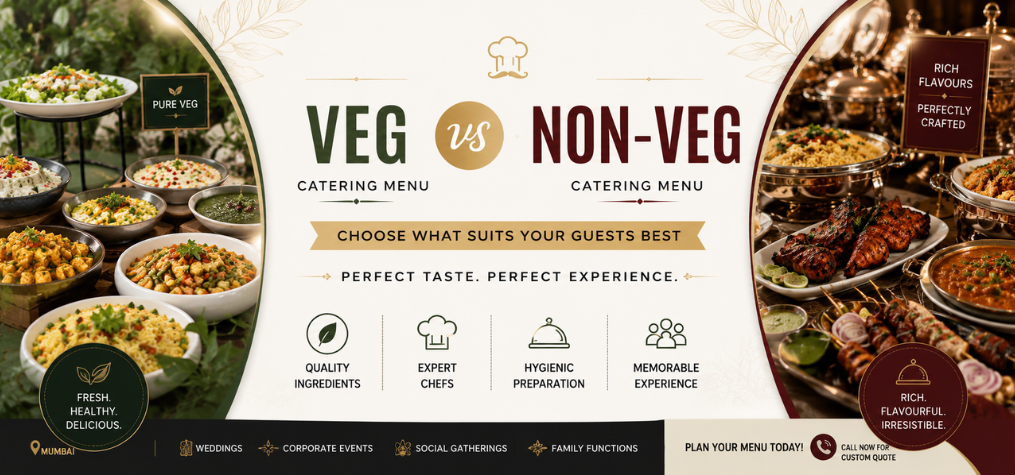
Choosing between a Veg vs Non-Veg catering menu depends on your event type, guest preferences, budget, cultural requirements, and service arrangement. For many Mumbai events, a well-planned mixed menu with separate counters works best, while smaller or religious functions may benefit from a focused vegetarian or non-vegetarian menu.
The best choice is not always the menu with the most dishes. It is the menu that suits your guests, fits the occasion, and can be served smoothly without compromising taste, hygiene, or presentation.
Why Is Choosing Between Veg and Non-Veg Catering Important?
Food preferences can vary widely at weddings, family functions, corporate events, religious gatherings, and private parties. Some guests may prefer vegetarian food, while others may expect chicken, mutton, fish, kebabs, or biryani.
If the menu is planned without considering the guest profile, one section may be underused while another becomes overcrowded. This can lead to food wastage, longer waiting times, and an uneven dining experience.
For example, a religious daytime function may need a pure vegetarian or satvik menu. A wedding reception with a mixed guest list may need separate veg and non-veg counters. A small Eid gathering may be better suited to a focused non-veg menu with selected vegetarian accompaniments.
The decision should therefore begin with the people attending the event, not only with personal preference.
What Is Included in a Vegetarian Catering Menu?
A vegetarian catering menu can offer much more than paneer, dal, rice, and roti. Modern veg catering in Mumbai includes Indian, regional, Asian, Continental, and live-counter options.
A balanced vegetarian menu usually includes starters, one or two main-course vegetables, paneer, dal, rice, breads, accompaniments, desserts, and beverages.
Popular Vegetarian Starters
Vegetarian starters should be easy to serve and appealing to different age groups.
Common options include:
- Paneer tikka
- Hara bhara kebab
- Dahi ke kebab
- Veg seekh kebab
- Cheese corn balls
- Stuffed mushrooms
- Veg crispy
- Spring rolls
- Aloo tikki
- Mini samosas
For larger events, it is better to choose a combination of grilled, fried, and lighter starters instead of selecting several items with a similar taste or texture.
Popular Vegetarian Main Course Options
A good vegetarian main course should include variety without becoming repetitive.
Suitable options may include:
- Paneer butter masala
- Paneer tikka masala
- Veg handi
- Mix vegetable curry
- Kofta curry
- Dal makhani
- Dal tadka
- Jeera rice
- Veg pulao
- Veg biryani
- Naan, roti, kulcha, or paratha
- Raita, salad, pickle, papad, and chutney
Vegetarian Live Counters
Live counters can make a vegetarian menu more interactive and suitable for weddings, engagements, birthdays, and corporate events.
Popular choices include:
- Chaat counter
- Dosa counter
- Pav bhaji counter
- Pasta counter
- Pizza counter
- Chinese counter
- Mocktail counter
- Jalebi counter
- Ice cream counter
A few well-chosen counters are usually more effective than adding too many stations that guests may not use.
What Is Included in a Non-Vegetarian Catering Menu?
A non-vegetarian catering menu generally includes chicken, mutton, fish, kebabs, biryani, gravies, breads, accompaniments, desserts, and beverages.
The final selection should depend on the event style and guest profile. A family dinner may need a focused menu, while a wedding reception may include several starters, premium main-course dishes, and live stations.
Popular Non-Vegetarian Starters
Non-veg starters often become one of the most discussed parts of the event menu.
Popular options include:
- Chicken tikka
- Tandoori chicken
- Mutton seekh kebab
- Chicken malai tikka
- Fish fry
- Chicken crispy
- Mutton cutlets
- Grilled chicken
- BBQ chicken
- Fish tikka
The number of starters should be practical. Too many similar chicken preparations can make the menu feel repetitive.
Popular Non-Vegetarian Main Course Options
A balanced non-veg main course can include:
- Butter chicken
- Chicken gravy
- Mutton curry
- Mutton rogan josh
- Fish curry
- Chicken biryani
- Mutton biryani
- Naan, rumali roti, or tandoori roti
- Raita, salad, chutney, and papad
If mutton, seafood, and premium kebabs are included, the menu budget may increase. These dishes also require careful quantity planning and service timing.
Veg vs Non-Veg Catering Menu: What Are the Main Differences?
The difference is not limited to the ingredients. Preparation, food handling, serving arrangements, cost, and guest expectations can also change.
| Factor | Vegetarian Menu | Non-Vegetarian Menu |
| Best suited for | Religious events, poojas, office lunches, family functions | Receptions, Eid gatherings, private parties, evening events |
| Cost direction | Usually budget to premium depending on counters | Usually mid-range to premium depending on meat and seafood |
| Menu variety | Indian, regional, Asian, Continental, live counters | Kebabs, biryani, chicken, mutton, seafood, grills |
| Handling needs | Standard hygiene and temperature control | Stricter storage, preparation, and temperature management |
| Guest acceptance | Inclusive for mixed and religious audiences | Best where guest preferences are known |
| Counter planning | Can be served from one or multiple sections | Separate counters recommended when veg food is also served |
A vegetarian menu is not automatically basic, and a non-vegetarian menu is not automatically premium. The final experience depends on dish quality, variety, service, and presentation.
When Should You Choose a Pure Vegetarian Menu?
A pure vegetarian menu is usually the right choice when the event has religious, cultural, or guest-comfort requirements.
It works particularly well for:
- Pooja functions
- Jain gatherings
- Satvik meals
- Religious ceremonies
- Baby showers
- Corporate lunches
- Community events
- Daytime weddings
- Family get-togethers
A pure veg menu also simplifies counter planning because all guests can dine from the same food sections.
Is a veg menu enough for a wedding?
Yes. A thoughtfully designed vegetarian wedding menu can offer a complete and premium experience.
Live chaat, paneer starters, regional dishes, fresh breads, rice preparations, desserts, beverages, and interactive counters can create enough variety without needing non-vegetarian dishes.
The key is to avoid filling the buffet with multiple similar gravies or repetitive paneer options.
When Should You Choose a Pure Non-Vegetarian Menu?
A focused non-vegetarian menu works well when most guests have similar food preferences and the event does not require a large vegetarian section.
It may be suitable for:
- Eid gatherings
- Family dinners
- House parties
- Private celebrations
- Birthday dinners
- Small receptions
- Close-group events
Even in a non-veg-focused menu, it is practical to include a few vegetarian side dishes, dal, rice, breads, salad, and dessert. This gives flexibility to guests who may not want meat in every course.
Who is a pure non-veg menu best for?
It is best for smaller or closely connected groups where the host has a clear understanding of guest preferences.
For a large wedding or corporate gathering, relying only on non-veg dishes may not provide enough comfort or choice for everyone.
When Is a Mixed Veg and Non-Veg Menu the Better Choice?
A mixed menu is often the safest option for weddings, receptions, corporate dinners, society functions, and large family celebrations.
It gives guests freedom to choose while allowing the host to serve a broader audience.
A mixed menu is especially useful when:
- The guest list includes different communities
- Some guests are strictly vegetarian
- The host does not know every guest’s preference
- The event has several age groups
- The function is large or formal
- Both families have different food traditions
The important part is not simply serving both menus. It is planning them properly.
Why Should Veg and Non-Veg Counters Be Separate?
Separate counters improve comfort, hygiene, and service flow. They also make it easier for guests to identify dishes without repeatedly asking the staff.
Vegetarian guests may prefer that serving spoons, plates, and preparation areas remain separate from non-veg food.
For large events, clear signs and sufficient distance between counters can reduce confusion and crowding.
What should be separated?
Ideally, separate arrangements should be considered for:
- Food counters
- Serving spoons
- Display labels
- Plates where required
- Service staff assignments
- Live stations
- Preparation and refill handling
The level of separation can be decided according to the venue, guest expectations, and event format.
Which Menu Is More Affordable: Veg or Non-Veg?
Vegetarian catering is often more affordable, but this is not always the case.
A simple chicken menu may cost less than a premium veg spread with imported ingredients, multiple live stations, elaborate desserts, and international cuisine.
Similarly, a non-veg menu with mutton, seafood, premium kebabs, and several biryani options may cost considerably more than a standard vegetarian menu.
The right comparison is between complete menus, not only between veg and non-veg labels.
For broader budgeting information, you can read Catering Services Cost in Mumbai – Pricing & Quotes.
What Affects the Cost of Veg and Non-Veg Menus?
Several factors influence the final catering quotation.
Number of guests
A larger guest count requires more food, serving staff, equipment, and counter space. However, bulk planning may sometimes improve the overall per-plate value.
Ingredient selection
Premium paneer, speciality vegetables, mutton, seafood, imported ingredients, and elaborate desserts can increase the cost.
Number of dishes
A menu with two starters and a focused main course will cost less than a buffet with several starters, live counters, multiple gravies, desserts, and beverages.
Live counters
Live chaat, pasta, grills, kebabs, mocktails, dosa, or dessert stations need additional staff, ingredients, and equipment.
Service style
Food delivery, a basic buffet, premium buffet presentation, live preparation, and table service all require different levels of planning.
How Should You Divide the Menu for a Mixed Event?
There is no fixed formula, but the menu should reflect the likely guest preferences.
For example, if most guests prefer non-veg food but a meaningful group is vegetarian, the veg section should still feel complete. It should not be treated as an afterthought with only one paneer dish and dal.
Similarly, if most guests are vegetarian, a smaller but focused non-veg section may be enough.
What should a complete veg section include?
A complete vegetarian section may include starters, one paneer dish, one vegetable dish, dal, rice, breads, salad, accompaniments, and dessert.
What should a complete non-veg section include?
A non-veg section may include one or two starters, a chicken or mutton main course, biryani or rice, breads, salad, and accompaniments.
Some items such as rice, breads, salad, beverages, and desserts may be shared if the counter setup and guest expectations allow it.
How Can You Avoid Food Wastage in a Mixed Menu?
Mixed menus can lead to wastage if quantities are split without understanding the guest profile.
Do not automatically divide the food equally between veg and non-veg. A 50-50 split may not match the actual preferences of your guests.
A better approach is to consider:
- Family food habits
- Event type
- Religious requirements
- Time of the function
- Guest age groups
- Previous event experience
- Confirmed dietary preferences
For example, an evening reception may have higher demand for non-veg starters, while vegetarian food may still be required in a complete and comfortable quantity.
What Menu Works Best for Different Events?
Different functions need different menu planning.
Weddings and receptions
A mixed menu often works best for weddings and receptions because the guest list is usually large and diverse.
Separate counters, clear labels, and balanced menu sections are important.
Corporate events
Vegetarian menus or mostly veg menus can be easier for corporate gatherings because they are inclusive and simple to manage.
For an evening corporate dinner, a smaller non-veg section can be added if appropriate.
Religious functions
Pure vegetarian, Jain, or satvik menus are usually preferred. Preparation requirements should be clearly discussed with the caterer.
Birthdays and house parties
The menu can be based more closely on the host’s preferences because the guest list is smaller and easier to understand.
Eid and festive gatherings
A non-veg-focused menu may work well, supported by vegetarian sides, breads, desserts, and beverages.
How Do You Choose Dishes That Work Well Together?
A good menu should feel like one complete meal rather than a collection of unrelated dishes.
Avoid selecting several items with the same base, gravy, or cooking style.
For example, if you have paneer tikka as a starter, you may not need multiple heavy paneer dishes in the main course. If biryani is the main attraction, the remaining dishes should support it rather than compete with it.
Balance the menu through:
- Different flavours
- Different textures
- Light and rich dishes
- Dry and gravy preparations
- Hot and cold items
- Familiar and speciality dishes
This makes the menu more enjoyable without unnecessarily increasing its size.
Why Should You Review Real Catering Work Before Finalizing?
A written menu tells you what will be served, but real event work shows how it may look and function.
Counter presentation, food arrangement, buffet flow, and service style can help you understand the caterer’s approach.
You can explore real examples and recent catering work on the official Jaffer Bhai Delhi Darbar Instagram page to review event presentation and menu variety.
Do not judge only by close-up food photographs. Look for full buffet arrangements, different event sizes, and how counters are presented.
How Jaffer Bhai Delhi Darbar Helps Plan Veg and Non-Veg Menus
Jaffer Bhai Delhi Darbar helps customers plan menus according to the event, guest count, venue, budget, and expected food preferences.
The purpose of menu planning is not to add the maximum number of dishes. It is to create a balanced selection that can be prepared consistently and served smoothly.
For example, a wedding reception may need complete veg and non-veg sections with separate counters. A small family gathering may only need a focused non-veg menu with selected vegetarian dishes.
By understanding the event before recommending the menu, the catering plan can be made more practical.
Conclusion
Choosing between a veg and non-veg catering menu depends on your guests, event type, budget, cultural requirements, and service setup. A pure vegetarian or non-vegetarian menu can work well for focused gatherings, while a mixed menu is often more suitable for large and diverse events.
The best menu is balanced, clearly arranged, and practical to serve. Jaffer Bhai Delhi Darbar can help you plan veg and non-veg options according to your event needs without overcrowding the buffet with unnecessary dishes.
For personalized menu recommendations and event-specific guidance, contact us and share your event requirements with the team.
FAQs
- Is a veg or non-veg catering menu better for weddings?
A mixed menu is often better for large weddings because guests may have different preferences. If the wedding is religious or most guests are vegetarian, a complete pure veg menu may be more suitable.
- Is vegetarian catering cheaper than non-vegetarian catering?
Vegetarian catering is usually more affordable, but the final cost depends on the complete menu. Premium veg ingredients, live counters, international cuisine, and elaborate desserts can increase the price.
- Should veg and non-veg food be served at separate counters?
Yes, separate counters are recommended for guest comfort, hygiene, and easy identification. Serving spoons, labels, and refill arrangements should also be managed separately where possible.
- How much vegetarian food should be planned for a mixed event?
The quantity should be based on the expected guest preferences rather than an automatic 50-50 split. Discuss your guest profile with the caterer so quantities can be planned realistically.
- Can Jain food be included with a mixed catering menu?
Yes, a separate Jain section can be planned alongside regular veg and non-veg menus. The preparation requirements, ingredients, utensils, and serving arrangement should be discussed clearly before the event.
July 15, 2026
 by Delhi Darbar Catering