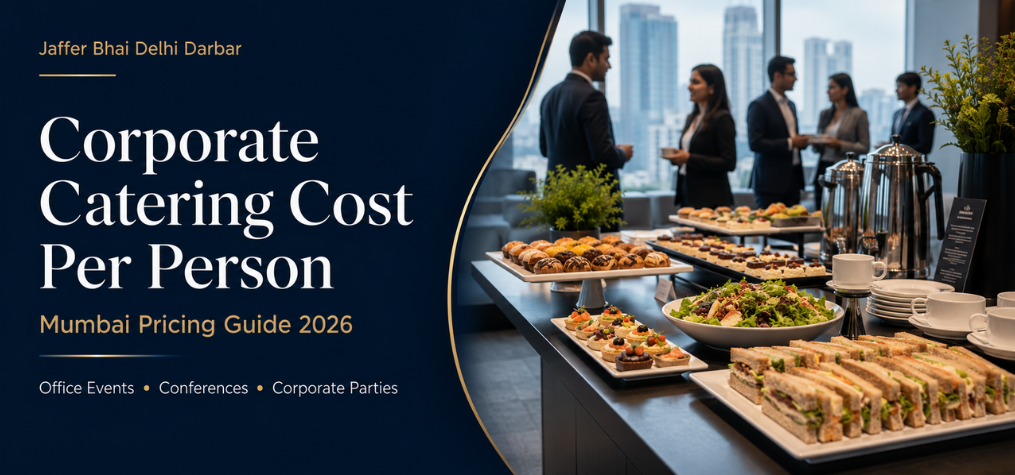
Corporate Catering Cost Per Person in Mumbai: Office Event Pricing Guide 2026
Understanding the Corporate catering cost per person in Mumbai helps businesses plan office lunches, conferences, training sessions, client meetings, product launches, and annual celebrations without unexpected expenses. In 2026, corporate catering can range from simple meal boxes to premium staffed buffets, depending on the menu, headcount, service style, and venue requirements.
Unlike a family celebration, corporate catering must usually work within a fixed schedule, approved budget, professional environment, and clear service timeline. The right catering plan should therefore balance food quality, punctuality, presentation, dietary requirements, and cost.
How Much Does Corporate Catering Cost Per Person in Mumbai?
Corporate catering prices in Mumbai can vary significantly because an office meal box and a fully serviced business dinner require very different arrangements.
A basic meal delivered to an office may only include food and packaging. A conference package may include morning tea, lunch, evening snacks, beverages, buffet equipment, service staff, and scheduled refills throughout the day.
The following price ranges can help businesses prepare an initial budget.
| Corporate Catering Format | Typical Requirement | Indicative Cost Per Person |
| Tea and Snacks | Tea, coffee, light snacks or refreshments | ₹200–₹400 |
| Vegetarian Box Meal | Main course, rice or bread, side and beverage | ₹250–₹400 |
| Non-Vegetarian Box Meal | Chicken-based meal, accompaniments and beverage | ₹350–₹550 |
| Vegetarian Buffet Lunch | Starters or sides, mains, rice, breads and dessert | ₹450–₹700 |
| Non-Vegetarian Buffet Lunch | Veg and non-veg mains, rice, breads and dessert | ₹550–₹850 |
| All-Day Conference Catering | Morning refreshments, lunch and evening snacks | ₹700–₹1,100 |
| Premium Corporate Dinner | Multi-course menu, service staff and premium presentation | ₹1,000–₹1,500+ |
These are indicative planning ranges rather than fixed package prices. The final corporate catering cost per person in Mumbai will depend on the selected menu, number of employees or guests, event location, service duration, and additional requirements.
Why Does Corporate Catering Pricing Vary Between Events?
Two companies may host events for the same number of people and still receive different catering quotes.
A training session with packed lunches has fewer operational requirements than a formal client dinner with welcome drinks, table service, premium starters, desserts, and professional presentation.
Menu complexity affects the price
A simple Indian lunch with dal, vegetables, rice, bread, salad, and dessert is usually easier to plan than a multi-cuisine buffet.
The cost may increase when the menu includes:
- Multiple starters
- Premium paneer dishes
- Chicken or mutton preparations
- Seafood
- International cuisine
- Live food stations
- Mocktails
- Premium desserts
Each additional item requires ingredients, preparation time, equipment, counter space, and service planning.
Guest count changes the calculation
Corporate catering is often priced per person, but the number of guests still affects the final rate.
A lunch for 25 employees may have a higher per-person cost than the same menu for 200 people because transportation, kitchen preparation, and basic logistics are distributed across fewer meals.
However, larger events may require additional buffet counters, staff, and equipment. Therefore, a higher guest count does not automatically guarantee a lower quote.
Service style makes a difference
Drop-off meals, meal boxes, self-service buffets, staffed buffets, and plated dinners all require different levels of support.
A simple delivery is generally more economical because the caterer does not need to arrange serving staff or manage the meal at the venue.
A formal buffet or plated dinner costs more because it may include setup, service, replenishment, clearing, and supervision.
Which Corporate Events Need Different Catering Budgets?
Corporate catering should match the purpose of the event. A menu that works for an internal training session may not be suitable for a board meeting or client-facing launch.
What Does an Office Lunch Usually Cost?
An office lunch is generally one of the most practical corporate catering formats.
It may be arranged as individual meal boxes or a compact buffet, depending on the team size and available dining space.
Meal boxes for team lunches
Meal boxes are suitable when employees need to eat at their desks, in meeting rooms, or during a short break.
They are useful for:
- Internal meetings
- Training sessions
- Working lunches
- Small team events
- Employee onboarding
- Overtime meals
A good meal box should be easy to open, neatly packed, comfortable to eat, and suitable for the available break time.
Buffet lunches for larger teams
Buffets work better when the office has a cafeteria, event area, terrace, or conference space.
A corporate buffet may include a starter, two main-course dishes, dal, rice, breads, salad, accompaniments, and dessert.
The menu should be selected according to the available serving time. Very complicated dishes or slow live counters may create unnecessary queues during a short office lunch break.
How Much Does Conference Catering Cost Per Person?
Conference catering usually includes more than one meal period.
A full-day conference may require:
- Welcome tea or coffee
- Mid-morning refreshments
- Buffet lunch
- Bottled water or beverage service
- Evening tea
- Snacks
- Service staff
- Scheduled setup and clearing
Because the service continues throughout the day, the total cost per person is usually higher than a single office lunch.
Why timing matters at conferences
Conference schedules are often strict. If lunch is planned for 1:00 p.m., the food should be ready before the session ends.
A delay of even 15 or 20 minutes can affect the speaker schedule, attendee movement, and venue operations.
The catering team should receive the complete event schedule in advance, including registration time, tea breaks, lunch, evening refreshments, and event closing time.
What Does Corporate Party Catering Usually Include?
Corporate parties, annual celebrations, award nights, festive events, and employee gatherings need a more relaxed and engaging menu than a regular office lunch.
The menu may include:
- Welcome drinks
- Passed starters
- Vegetarian and non-vegetarian sections
- Main-course buffet
- Live counters
- Desserts
- Mocktails
- Service staff
- Premium presentation
The price depends on how formal the event is and whether it is being held in an office, banquet hall, hotel, outdoor venue, or rented event space.
When is a premium menu worth considering?
A premium menu may be appropriate for client events, annual celebrations, leadership dinners, business milestones, or formal networking evenings.
For internal training sessions and everyday office meals, a simpler and more efficient menu may offer better value.
What Is Included in Corporate Catering Cost Per Person?
The phrase “cost per person” does not always mean the same thing across catering quotations.
Some quotes include food and delivery only. Others include the complete buffet setup, service staff, equipment, and clearing.
Before approving a vendor, ask for a written list of inclusions.
Food and menu planning
The quote should mention the selected menu or clearly describe the number of dishes included.
It should also clarify whether beverages, desserts, accompaniments, and dietary alternatives are part of the package.
Packaging or buffet setup
Meal-box packages may include food containers, cutlery, tissues, labels, and outer packaging.
Buffet packages may include food warmers, serving dishes, counters, table linen, serving spoons, and basic presentation.
Service staff
Ask whether servers, buffet attendants, supervisors, and clearing staff are included.
For a corporate event, professional and well-coordinated service is especially important because the meal often has to follow a fixed agenda.
Transportation
Confirm whether delivery to the office or event venue is included in the quotation.
The price may change based on distance, access time, parking restrictions, tolls, loading arrangements, and multiple delivery points.
Taxes and additional charges
Ask whether taxes are included and whether there are additional charges for:
- Extra guests
- Last-minute menu changes
- Extended service hours
- Additional delivery trips
- Premium crockery
- Special counters
- Branding requirements
A transparent quotation makes internal approval and vendor comparison easier.
Box Meals or Buffet: Which One Offers Better Value?
The better option depends on the event, not only the price.
When Should You Choose Box Meals?
Box meals work well when speed, hygiene, portability, and individual portions are the main priorities.
They are suitable for offices with limited dining space or short lunch breaks.
Advantages of box meals
Box meals provide portion control and make distribution easier. They can also simplify dietary labelling for vegetarian, non-vegetarian, Jain, or special meals.
Limitations of box meals
They offer less variety than a buffet and may not create the right impression for formal client events or celebrations.
Food quality can also be affected if the boxes remain packed for too long before service.
When Should You Choose a Buffet?
Buffets work better for conferences, annual events, corporate dinners, workshops, and larger gatherings where guests need more choice.
Advantages of a buffet
A buffet provides menu variety and allows guests to select portions based on their preferences.
It can also feel more suitable for a formal or celebratory occasion.
Limitations of a buffet
A buffet needs enough space, setup time, service staff, and proper queue planning.
If only one counter is arranged for a large group, employees may spend too much of their break waiting for food.
Should You Choose a Veg, Non-Veg, or Mixed Corporate Menu?
The best option depends on employee preferences, company policy, event format, budget, and dietary requirements.
Vegetarian menus are often easier to serve across diverse teams, especially for internal meetings, daytime conferences, and events where guest preferences are not fully known.
Non-vegetarian options may be included for corporate dinners, annual parties, or events where the guest profile supports them.
For a detailed comparison, read Veg vs Non-Veg Catering Menu by Jafferbhai Catering – What to Choose for Your Event.
When does a vegetarian menu work best?
A vegetarian menu is practical for:
- Training sessions
- Daytime conferences
- Mixed employee groups
- Religious or cultural events
- Office lunches
- Meetings with external guests
A complete veg menu should still offer variety through starters, paneer or vegetable dishes, dal, rice, breads, desserts, and beverages.
When does a mixed menu work better?
A mixed menu may be suitable for annual parties, festive celebrations, evening conferences, client dinners, and employee events where both preferences are expected.
Veg and non-veg counters should be clearly labelled and managed separately to improve comfort and avoid confusion.
How Should Dietary Requirements Be Managed?
Corporate events often include guests with different dietary needs.
The organizer should ask attendees about important requirements before finalizing the menu.
These may include:
- Jain food
- Satvik food
- Vegan meals
- Gluten-sensitive options
- Nut allergies
- Dairy restrictions
- Low-spice meals
- Other food allergies
Why should special meals be labelled?
Clearly labelled meals reduce confusion and help prevent guests from receiving the wrong food.
For individual requirements, sealed and named meal boxes may be more practical than placing a small special section inside a large buffet.
The caterer should receive the final dietary list early enough to plan separate preparation and packing.
How Do Office Location and Venue Rules Affect Cost?
Mumbai offices and corporate venues can have complex access requirements.
A catering team may need to coordinate with security, loading areas, service lifts, parking, building management, and event organizers before setup begins.
High-rise office buildings
High-rise commercial buildings may have fixed loading times or restrictions on using passenger lifts for catering equipment.
These conditions can increase setup time and should be communicated before the event.
Business parks
Large business parks may require entry permissions, vehicle details, staff identification, or advance gate approvals.
Delays at the entrance can affect food temperature and the event schedule.
Banquet and conference venues
Some venues provide tables, buffet counters, crockery, or kitchen access, while others require the caterer to arrange everything.
Clarifying venue inclusions can prevent duplicate costs.
How Can Companies Control Corporate Catering Costs?
Reducing the budget does not have to mean serving poor-quality food.
The most effective savings usually come from better planning.
Choose the right service format
Do not book a full buffet with staff if the team only needs individual meals during a short meeting.
Similarly, avoid using basic meal boxes for an important client dinner where presentation matters.
Keep the menu focused
A concise menu with good-quality dishes often performs better than an oversized spread with repetitive options.
For example, one strong starter, two mains, dal, rice, breads, salad, and dessert may be enough for a standard office buffet.
Avoid unnecessary live counters
Live counters are useful for celebrations and interactive events, but they may not add value to a short conference lunch.
Add them only when the event format and guest experience justify the extra cost.
Confirm the guest count
A realistic guest count helps prevent excessive food ordering.
Companies should also clarify how additional attendees will be charged if attendance exceeds the confirmed number.
Use shared menu items intelligently
For a mixed buffet, rice, breads, salads, desserts, and beverages may sometimes be shared between veg and non-veg sections, provided the counter arrangement remains clear and comfortable.
How Should You Compare Corporate Catering Quotes?
Do not compare quotations using only the final per-person number.
A lower quote may exclude important services that another caterer has already included.
For broader pricing guidance, read Catering Services Cost in Mumbai – Pricing & Quotes.
Compare the same menu
Ask all shortlisted caterers to quote for a similar menu and service format.
Comparing a basic meal box with a staffed premium buffet will not provide a useful result.
Review the inclusions
Check whether the quotation covers:
- Food
- Packaging
- Transport
- Buffet equipment
- Service staff
- Crockery
- Beverages
- Dessert
- Setup
- Clearing
- Taxes
Check operational experience
Ask whether the caterer has managed office events, conferences, or corporate gatherings with a similar headcount and schedule.
Corporate catering requires punctual delivery and efficient service, not only good food.
Confirm the backup plan
Ask how delays, extra attendees, late agenda changes, or venue-access problems will be handled.
A practical backup process is particularly important for client-facing events.
How Jaffer Bhai Delhi Darbar Helps Plan Corporate Catering
Jaffer Bhai Delhi Darbar can help businesses plan catering according to the event type, number of attendees, venue, food preference, service style, and budget range.
The recommended format may differ for every corporate requirement.
A short internal meeting may need neatly packed meals. A full-day conference may require scheduled tea breaks and lunch. An annual celebration may need a larger buffet, starters, beverages, desserts, and service staff.
You can also explore real event work and recent catering presentations on the official Jaffer Bhai Delhi Darbar Instagram page to understand food presentation and service setups.
Contact for Corporate Catering in Mumbai
To receive a relevant corporate catering recommendation, share your event details with Jaffer Bhai Delhi Darbar before requesting a final quotation.
Keep the following information ready:
- Event date
- Office or venue location
- Number of attendees
- Event type
- Meal timings
- Veg, non-veg, or mixed preference
- Service format
- Dietary requirements
- Budget range
- Building-access instructions
The team can then suggest suitable menu combinations, service options, and an event-specific quotation.
Conclusion
The corporate catering cost per person in Mumbai depends on much more than the selected dishes. Guest count, meal format, service staff, venue access, dietary requirements, timing, and presentation can all influence the final quotation.
Meal boxes are practical for working lunches and short meetings, while staffed buffets are more suitable for conferences, client events, and corporate celebrations. Jaffer Bhai Delhi Darbar can help businesses choose a format that suits the event without adding unnecessary menu or service costs.
For a customized office or corporate-event quotation, contact us and share your requirements with the team.
FAQs
1. What is the average corporate catering cost per person in Mumbai?
Corporate catering may range from approximately ₹200 for basic refreshments to ₹1,500 or more for a premium corporate dinner. The final price depends on the menu, guest count, service format, venue, and event duration.
2. Are meal boxes cheaper than a corporate buffet?
Yes, meal boxes are generally more economical because they need less setup and fewer service staff. Buffets cost more when they include counters, equipment, attendants, presentation, and clearing support.
3. What is included in corporate catering cost per person?
It may include food, packaging or buffet setup, delivery, and basic service. Staff, crockery, live counters, beverages, taxes, and extended service may be included or charged separately depending on the package.
4. Can corporate menus include Jain and special dietary meals?
Yes, Jain, vegan, low-spice, allergy-sensitive, and other special meals can be planned when requirements are shared in advance. Separate labelling and packaging are recommended to avoid confusion.
5. How early should a company book corporate catering?
Small office meals should ideally be confirmed several days in advance, while conferences and large corporate events require more planning. Early confirmation gives the caterer time to plan the menu, staff, venue access, and dietary requirements properly.
July 30, 2026
 by Delhi Darbar Catering